
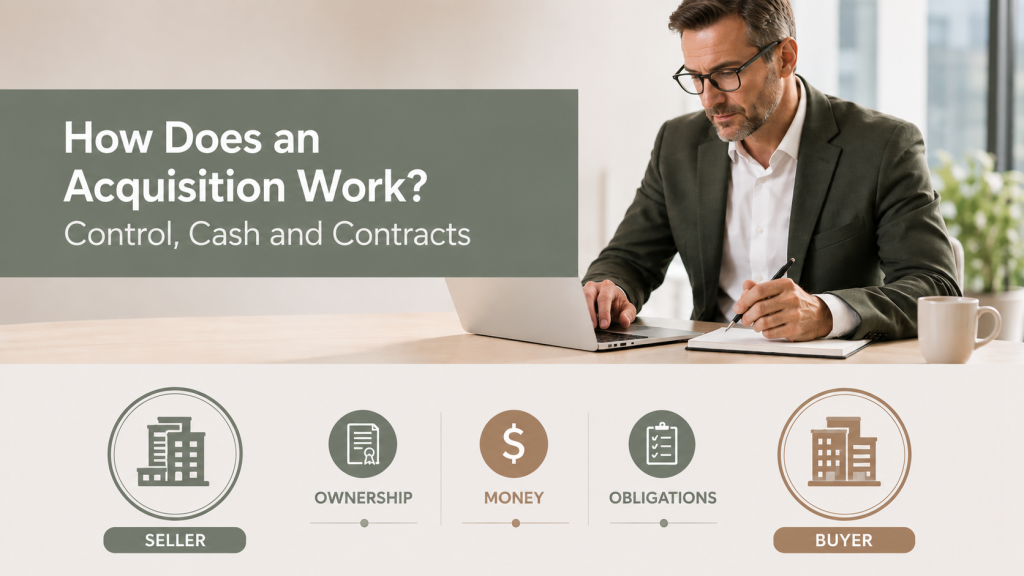
How Does an Acquisition Work? Control, Cash and Contracts
How does an acquisition work? One party buys enough shares or assets of a business to take control of it. In practice, three things change hands: ownership, money and obligations.
If you want the stage-by-stage sequence, read our M&A process guide. If you are new to the topic, start with What Is M&A? A Beginner’s Guide.
What Actually Changes Hands in an Acquisition?
Ownership moves first. In a share acquisition, the buyer purchases shares, so the company remains the same legal entity under new owners. In an asset acquisition, the buyer purchases selected assets or a business unit, and the seller’s company carries on without them.
This choice is the heart of the acquisition deal structure. It affects liabilities, tax, approvals and what happens to people and contracts.
How Does the Buyer Pay for an Acquisition?
The headline price is rarely paid in one go. Buyers may pay in cash, shares or a mix, and part of the price can be deferred.
Illustrative example: a buyer agrees to acquire a company for ₹100 crore:
- ₹70 crore is paid in cash at closing.
- ₹10 crore is held in escrow for an agreed period to cover claims that surface later.
- ₹20 crore is an earn-out, paid only if the business meets agreed revenue targets.
The seller’s real outcome depends on what happens after closing, not just on the headline number. DealCraft’s free First Year Associate’s Deal Vocabulary explains escrow, earn-outs and similar terms in plain language.
Real example: in 2026, upGrad agreed to acquire Unacademy’s parent, Sorting Hat Technologies, in an all-share deal. The CCI approved the combination in July, about two months after the filing, clearing a key step toward completion.
What Happens When a Company Is Acquired: Employees, Contracts and Customers
It depends on the structure. In a share acquisition, the company remains the employer and the contracting party, so employees and most contracts carry on.
An asset acquisition works differently. Contracts, licences and employment arrangements generally do not move automatically, so each may need consent, a transfer agreement or a fresh contract.
One clause matters in both cases: the change-of-control clause. Some contracts let a customer or supplier terminate or renegotiate when the other party’s ownership changes. A buyer who overlooks one could lose a key customer soon after closing.
How Is an Acquisition in India Different for Listed Companies?
Buying a listed company brings in public shareholders, and Indian law protects them.
Under the SEBI Takeover Regulations, an acquirer that reaches 25% or more of voting rights, or gains control, must make an open offer to public shareholders for at least 26% of the company’s shares. Competition law may also apply, depending on deal size.
Example: a logistics group agrees to buy 30% of a listed warehousing company from its promoters. Because that is above 25%, the deal does not end with the promoters. The buyer must also invite public shareholders to sell, at a price that meets SEBI’s pricing rules.
Acquisition at a Glance
| Question | Short answer |
|---|---|
| What changes hands? | Shares or assets, and with them control |
| How is it paid? | Cash, shares, deferred amounts or a mix |
| What happens to people and contracts? | It depends on the structure |
| Who must agree? | Sellers, and sometimes regulators or public shareholders |
The Bottom Line
An acquisition is not one event. It is a set of transfers covering ownership, money and obligations, each with its own rules. For any deal, ask three questions: what is being bought, how is it paid for, and who has to agree. Those answers explain most of what happens when a company is acquired.
To build this understanding, explore DealCraft Academy’s Master M&A Fundamentals (Foundation Track), which covers the deal lifecycle, term sheets, key Share Purchase Agreement clauses and India’s legal framework for M&A.
Frequently Asked Questions
How does an acquisition work in simple terms?
One company buys enough shares or assets of another to control it. The parties agree a price, the buyer checks the business, an agreement is signed, approvals are obtained and payment is completed.
What happens to employees after an acquisition?
In a share acquisition, employees stay with the same employer. In an asset acquisition, employment generally has to be transferred or offered afresh.
How is an acquisition paid for?
Through cash, buyer shares or a mix, sometimes with part of the price held in escrow or paid later through an earn-out.
When is an open offer required in an acquisition in India?
When an acquirer reaches 25% or more of voting rights in a listed company or acquires control, subject to certain exemptions.
Can a company refuse to be acquired?
Private company shareholders decide whether to sell. In a listed company the board can oppose a bid, but each shareholder decides whether to sell.
Recent Comments